
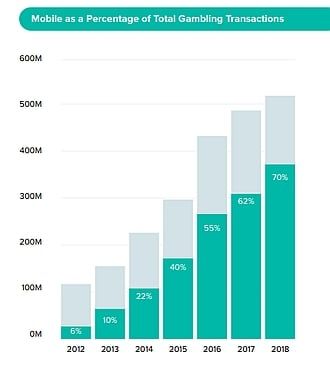
Few sectors have experienced a technological transformation as rapid or as sweeping as the gambling industry. What was once confined to brick-and-mortar casinos, licensed betting shops, and land-based lottery terminals has migrated almost entirely into the palm of the user’s hand. The growth of mobile gambling represents one of the most significant shifts in consumer entertainment of the past two decades, driven by the convergence of high-speed connectivity, sophisticated mobile hardware, secure digital payments, and evolving regulatory frameworks.
Understanding this growth requires more than acknowledging that people now bet on their phones. It demands an examination of the underlying technologies, the shifting demographics, the economic incentives, and the challenges that will define the next phase of the market.
The Technological Foundation
Mobile gambling could not have scaled without a mature technical ecosystem. Several converging developments made it viable:
- Ubiquitous high-speed connectivity: The global rollout of 4G LTE and, more recently, 5G networks has reduced latency to levels that support real-time wagering, live dealer streaming, and instant transaction confirmation.
- Powerful mobile hardware: Modern smartphones ship with processors and graphics capabilities that rival entry-level laptops, enabling rich interfaces, animated slots, and HD video feeds.
- HTML5 and responsive design: The decline of Adobe Flash forced operators to rebuild their platforms on open web standards, which in turn made games accessible across iOS, Android, and desktop browsers without separate native builds.
- Secure payment infrastructure: Tokenized card payments, digital wallets, and instant bank transfer APIs have streamlined deposits and withdrawals while reducing friction and fraud exposure.
The result is a user experience that no longer feels like a compromise. Players can open a game in seconds, authenticate biometrically, and place a wager without leaving the app.
The Shift in Consumer Behavior
Behavioral change has followed technological capability. Mobile devices have made gambling an activity of micro-moments rather than dedicated sessions. A commuter can place a sports bet during a train ride; a user can spin a slot during a lunch break. This fragmentation of play has expanded the total addressable market considerably.
Several behavioral patterns stand out:
Market Scale and Regional Dynamics
The commercial trajectory is substantial. Mobile channels now account for the majority of online gambling revenue in most mature markets, and their share continues to rise as smartphone penetration deepens in emerging economies.
| North America | State-level legalization of sports betting, strong app adoption | Fragmented but expanding |
| Europe | Mature online markets, high smartphone penetration | Established and highly regulated |
| Asia-Pacific | Large mobile-first populations, rapid digital payments adoption | Mixed; strict in several jurisdictions |
| Latin America | Young demographics, growing smartphone access | Liberalizing in key markets |
| Africa | Mobile money infrastructure, sports betting popularity | Varies widely by country |
What these regions share is a common enabler: the smartphone. Where device penetration rises and payment rails mature, mobile gambling tends to follow, provided the legal environment permits it.
Regulation as a Catalyst and a Constraint
Regulation plays a dual role. In markets that have legalized and licensed mobile gambling, regulation has acted as a catalyst by legitimizing operators, mandating consumer protections, and unlocking advertising and payment channels. In markets that prohibit it, regulation constrains growth but does not eliminate demand, often pushing activity toward unlicensed offshore platforms.
Responsible gambling frameworks have become a standard component of licensed operations. These include deposit limits, self-exclusion tools, age verification, and real-time monitoring for problematic play patterns. Far from being purely restrictive, these measures support long-term market stability by preserving consumer trust.
Challenges on the Horizon
Sustained growth is not guaranteed. Operators and regulators face several systemic challenges:
- Data privacy and security: Handling sensitive financial and personal data across distributed mobile environments demands continuous investment in encryption and compliance.
- Addiction and public health: The convenience of mobile access raises legitimate concerns about problem gambling, requiring proactive intervention design.
- Regulatory fragmentation: Operators must maintain compliance across dozens of jurisdictions with differing rules, which increases cost and complexity.
- Market saturation: In mature markets, customer acquisition costs are rising, pushing operators toward consolidation and differentiation.
- Platform dependency: App store policies and mobile OS changes can materially affect distribution and monetization.
What Comes Next
The next phase of mobile gambling will likely be defined by personalization, artificial intelligence, and integration with adjacent digital experiences. AI-driven recommendation engines can tailor content and offers, while machine learning models strengthen fraud detection and responsible gambling monitoring. Cryptocurrency and blockchain-based settlement may find niche applications, though mainstream adoption remains uncertain given regulatory scrutiny.
What is clear is that the mobile channel is no longer a secondary access point. It is the primary arena in which the gambling industry competes, innovates, and is judged. For technology providers, operators, and regulators alike, the strategic question is no longer whether mobile gambling will grow, but how responsibly and sustainably that growth can be managed.